

The importance of learning History and Geography in today’s modern world
3/23/2026 2:59:00 PM
Discover the importance of learning History and Geography in the modern world. Learn how Assumption Convent School nurtures critical thinking and empathy.
Author: Aranka Mennen
As a teacher, I often look around at my students and notice how much the world has changed since I was their age. Today’s children live in a digital world that follows them everywhere: in their pockets, on their wrists, even in their classrooms. Phones and games keep them entertained and connected, yet these same tools often pull them away from the real world. Many spend hours in front of screens but know little about the earth beneath their feet or the people who came before them. This is why I believe History and Geography remain two of the most important subjects at school.
I love seeing the spark in a child’s eye when they discover something about their own history. Often, children don’t realise how much their identity is tied to the past until they are asked to share it. On Heritage Day, for example, our school encourages pupils to come dressed in traditional clothing or bring food from their culture. What I see more than colourful outfits and delicious meals is pride. Children start conversations at home, asking parents and grandparents about their traditions. Those stories make them feel connected and confident.
Too many children today grow up knowing more about global celebrities than their own family stories. History reminds them of where they come from and helps them respect others whose traditions may differ from theirs. A child who knows their story becomes more grounded and understanding of the world around them.
Children learn that diversity does not divide us; it enriches us. By seeing how traditions differ, yet share similarities, children gain respect for others while becoming more confident in their own identity. Intolerance runs rampant through our world causing wars and conflict. History teaches not only empathy, but respect and understanding while still standing firm in your morals and values.
History also trains children to think critically
When we study historical sources, we ask questions: Who wrote this? What might they have left out? Can we trust it? These habits of questioning are essential in a world filled with information; some true, much of it false. In today’s fast paced world where money seems to talk, History reminds us of the power of our voices. It teaches what goes wrong when those voices are silenced by systems and those in power. To engage with History is to discover how to change the world.
I often tell my students that History is not about memorising dates; it is about learning how to think. One day, they will make decisions that affect their communities. If they can analyse, question, and weigh evidence, they will be less likely to fall for misleading headlines or empty promises. That, to me, is one of the greatest gifts History gives them.
If History answers “who we are,” geography answers “where we are.” It’s not about memorising maps but about understanding how our world works and why it matters. Geography shows children how rivers shape towns, how weather affects crops, and how human choices impact the environment. At a time of climate change and dwindling resources, this knowledge is vital.
I think of geography as a love letter to the earth
It teaches children to appreciate the beauty around them (mountains, rivers, forests) and to recognise their responsibility in caring for it. When they learn how products are made, they begin to understand the hidden costs of consumption. This awareness plants seeds of responsibility and empowers them to make thoughtful choices.
Technology has a way of narrowing children’s vision. I once asked students for their home addresses, and a few gave me their email addresses instead. On bus trips, they bury themselves in their phones, barely looking up at the scenery. They trust GPS apps without ever opening a physical map, so their sense of place becomes limited to a small glowing screen.
Geography and History are antidotes to this. They lift children’s eyes from their devices and invite them to notice the world; the landscapes they pass, the people they meet, and the monuments that tell stories of the past. They remind children that life is not only about what happens on a screen but also about what happens around them.
Modern education often focuses narrowly on preparing children for jobs
While career preparation is important, schools should also prepare children to live meaningful lives; to care about people, respect cultures, and love the planet.
This is why I love teaching the Social Sciences. Geography and History nurture qualities that no computer program can teach: empathy, awareness, responsibility, and curiosity. They remind children that learning is not just about earning a living, but about being fully human.
I believe Geography and History are more relevant now than ever. History connects children to their heritage and trains them to think critically. Geography connects them to the earth and helps them take responsibility for its future. Together, they ground children in what truly matters: their roots, their world, and their humanity.
Technology will continue to shape our future, but without Geography and History, we risk raising a generation skilled with devices yet disconnected from life itself. Teaching these subjects is not just my profession; it is my calling to remind children of who they are, where they are, and how they can make the world a better place.

Founded in 1946 by the Missionary Sisters, Assumption Convent is an independent Catholic girls schools in the heart of Johannesburg offering affordable, quality education.
AFFILIATIONS




OUR BROTHER SCHOOL

People also search for: private schools johannesburg ; private girls schools johannesburg ; girls schools johannesburg ; catholic schools johannesburg ; independent schools johannesburg ; catholic girls school ; best schools in gauteng south africa ; private christian schools ; best private schools in gauteng ; affordable private schools in johannesburg ; affordable private schools in gauteng ; preprimary schools johannesburg ; preschools johannesburg ; private primary schools johannesburg ; private primary schools ; primary schools in gauteng south africa ; christian primary schools ; affordable high schools in johannesburg ; high schools in johannesburg ; catholic high schools ; private high school ; aftercare schools ; after school programs
© 2025 by Assumption Convent School | Protection of Personal Information Policy | PAIA Manual
Assumption Convent School - Academic Scholarship Application
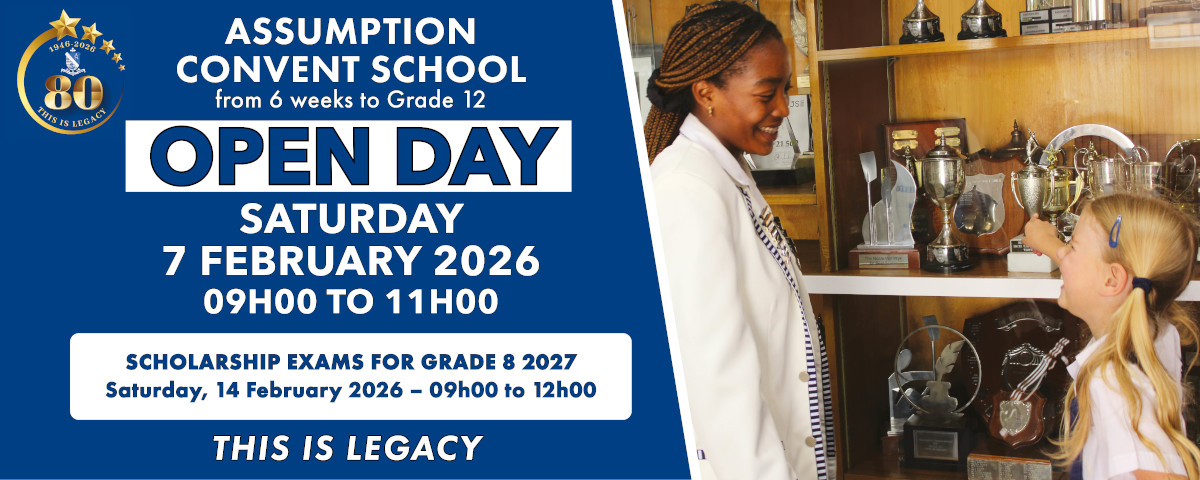
Each year Assumption Convent School offers a limited number of Open Academic Scholarships to female students entering Grade 8. Assumption Convent School would like to offer current Grade 7 girls an opportunity to apply for this prestigious scholarship for 2027. Scholarships will be awarded to female students entering Grade 8, who excel academically. This scholarship is open to Grade 7 Assumption Convent School students as well.