

Part 2 - From brain to muscle: how your nervous system makes you a better athlete
10/28/2026 11:40:00 AM
In Part 1, we discovered how your nerves collect information and send lightning-fast signals. Now let's see how those signals turn into powerful, well-timed movement.
Author: Bianca Naudè
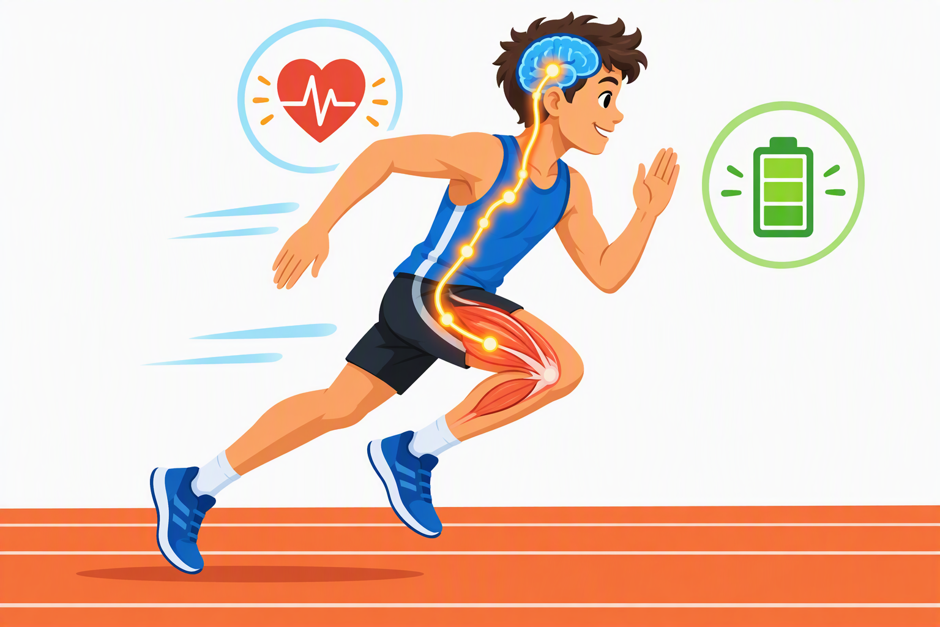
Figure 2: From brain to muscle – signals travel down the spinal cord to power a sprinter's legs, while the heart works harder to supply energy.
In Part 1, we discovered how your nerves collect information and send lightning-fast signals. Now let's see how those signals turn into powerful, well-timed movement – and why your nervous system matters for training, recovery and even feeling tired.
Built-in rhythm
Walking, running and swimming are all repeated patterns of movement. Networks of neurons in the spinal cord help create these rhythms, while the brain and sensory feedback start, adapt and control them. The spinal cord does not run a sporting movement on its own – movement comes from teamwork between the spinal cord, the brain, your sensors and your muscles.
Switching muscles on
A muscle cannot contract properly without a signal from a nerve. Motor neurons carry messages from the brain and spinal cord to your muscles. At the neuromuscular junction, the nerve releases a chemical called acetylcholine, which sparks electrical activity in the muscle fibre so that it can tighten and create movement.
Need more power? Your nervous system recruits more motor units (groups of muscle fibres controlled by one nerve) and fires them more often. A swimmer's explosive start needs fast, strong activation of the legs and core, while a smooth stroke needs precise, careful timing.
Exercise and recovery
When you exercise, your muscles need more energy and oxygen. The autonomic nervous system – the "automatic" part you don't have to think about – raises your heart rate, adjusts your blood vessels and makes you sweat, with the brainstem helping to coordinate it all. Afterwards, parasympathetic activity helps bring your heart rate back down. Recovery also depends on drinking enough water, eating well, cooling down and how hard you trained. Your body's systems work as a team, never alone.
Why practice really does make perfect
You might be strong but still struggle with a skill if your muscles fire at the wrong time. Practice gives your nervous system the chance to polish movement patterns and use feedback to correct mistakes. Over time, a familiar skill becomes more consistent and needs less conscious effort – because your brain, spinal pathways and nerves are all learning together. Think of a beginner swimmer who concentrates on arms, breathing and kicking separately. With practice, these actions blend into one smooth freestyle stroke.
Feeling tired?
During long or intense exercise, it gets harder to keep up the same movement or force. This fatigue can involve the muscles, the signals at the neuromuscular junction and the brain's ability to keep sending strong commands. A short sprint tires you out differently from a long endurance race, so fatigue is never caused by just one thing.
The final whistle
Your brain plans, your spinal cord carries messages and coordinates quick responses, and your nerves connect everything to your muscles. Together, they let you move, balance, react to danger and keep your body running smoothly – whether you are walking to class or racing for gold.
Take away
For athletes and coaches, the message is simple: training your body also means training your nervous system. Focus on high-quality, well-timed repetitions rather than just piling on extra effort, because practice teaches your brain and nerves to fire the right muscles at the right moment. Use feedback – from your own body, a coach or video – to spot and fix mistakes early and build skills step by step until they become smooth and automatic. Mix explosive drills, like swim starts and sprints, with slower technique work, since power and precision both depend on clear signals from nerve to muscle. Finally, treat recovery as part of training: drink enough water, eat well, cool down properly and plan sessions so tiredness doesn't undo your hard work. Look after your hidden wiring, and it will look after your performance.

Founded in 1946 by the Missionary Sisters, Assumption Convent is an independent Catholic girls schools in the heart of Johannesburg offering affordable, quality education.
AFFILIATIONS




OUR BROTHER SCHOOL

People also search for: private schools johannesburg ; private girls schools johannesburg ; girls schools johannesburg ; catholic schools johannesburg ; independent schools johannesburg ; catholic girls school ; best schools in gauteng south africa ; private christian schools ; best private schools in gauteng ; affordable private schools in johannesburg ; affordable private schools in gauteng ; preprimary schools johannesburg ; preschools johannesburg ; private primary schools johannesburg ; private primary schools ; primary schools in gauteng south africa ; christian primary schools ; affordable high schools in johannesburg ; high schools in johannesburg ; catholic high schools ; private high school ; aftercare schools ; after school programs
© 2025 by Assumption Convent School | Protection of Personal Information Policy | PAIA Manual
Assumption Convent School - Academic Scholarship Application

Each year Assumption Convent School offers a limited number of Open Academic Scholarships to female students entering Grade 8. Assumption Convent School would like to offer current Grade 7 girls an opportunity to apply for this prestigious scholarship for 2027. Scholarships will be awarded to female students entering Grade 8, who excel academically. This scholarship is open to Grade 7 Assumption Convent School students as well.