

Part 1- your body's hidden wiring: How your nerves help you play sport
10/19/2026 1:52:00 PM
Discover how your nerves help you play sport by controlling movement. Read our guide to train your nervous system and boost your athletic performance.
Author: Bianca Naudè
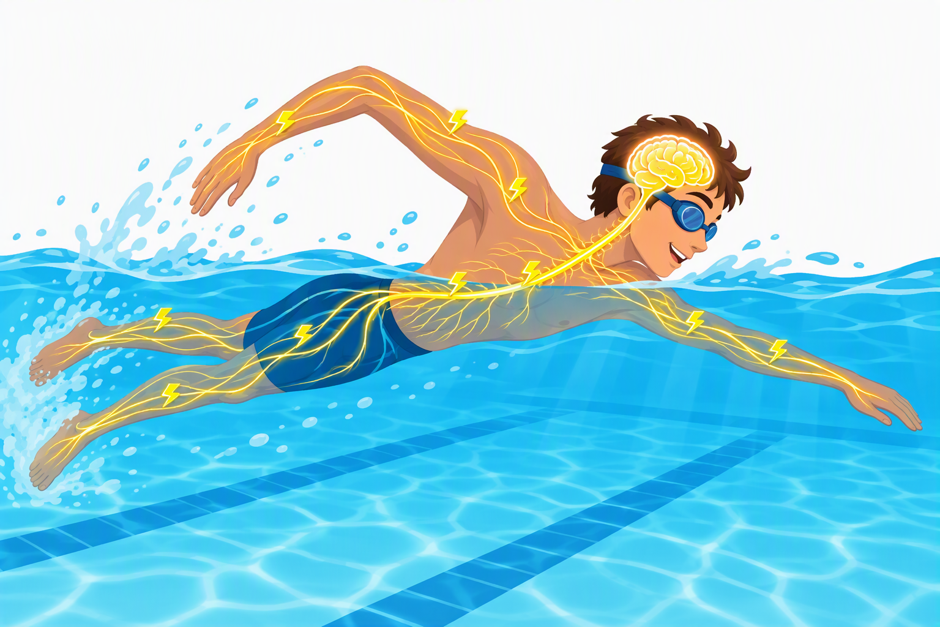
Figure 1: Your nervous system at work – the brain, spinal cord and nerves send lightning-fast signals to every part of a swimmer's body.
Every time you dive into a pool, kick a ball or sprint for the finish line, a super-fast communication network is working behind the scenes. It is called the nervous system, and together with the spinal cord it controls almost everything your body does – from moving and balancing to breathing and keeping your heart beating. Its big job is to keep your body stable and in control, a balance scientists call homeostasis.
Your body is always "listening"
Even when you are not thinking about it, your body is collecting information. Tiny sensors called receptors detect pressure, temperature, muscle stretch and where your arms and legs are. They turn this information into electrical signals that travel along sensory nerves to the spinal cord. From there, the message either heads up to the brain or is handled by circuits inside the spinal cord itself. Adjusting your posture can happen automatically but deciding how to catch a ball flying towards you needs your brain.
Feedback keeps you on track
Your nervous system constantly checks how a movement is going – this is called sensory feedback. When you walk, sensors in your feet and legs report when you touch the ground and how your joints bend, so your muscles can adjust and keep you balanced. In freestyle swimming, special sensors called proprioceptors track muscle length, tension and limb movement. If your body position slips in the water, your nervous system adjusts your muscles to fix your stroke, while the spinal cord carries the signals between your brain and muscles.
Lightning in your nerves
Nerve cells, or neurons, send messages as electrical pulses called action potentials. When a neuron is stimulated enough to reach its "threshold", sodium ions rush into the cell, then potassium ions flow out and the cell resets. This rapid change travels along the nerve without fading away.
Many nerves are wrapped in a fatty coating called the myelin sheath, which works like the plastic insulation on a cable. Small gaps called nodes of Ranvier let the signal "jump" from gap to gap – a process called saltatory conduction – which makes it much faster. That speed matters in sport, where muscles must fire at exactly the right moment. Damage to myelin can slow down or disrupt these signals.
Passing the message on
Where two neurons meet, at a synapse, the signal is passed on by chemical messengers called neurotransmitters. Some make the next cell more likely to fire; others calm it down. This balance lets your nervous system filter information instead of passing every signal along unchanged.
In the spinal cord, connector neurons called interneurons link sensory and motor neurons so that reflexes happen in a flash. But the spinal cord is not the boss on its own – the brain sends signals down the spinal cord to fine-tune reflexes and movements to suit the situation.
So next time you react in a split second during a game, thank your hidden wiring! In Part 2, we will look at how your nerves power your muscles, help you recover and make practice pay off.
Take away
For athletes and coaches, the message is simple: every skill you perform depends on your nervous system, so train it as carefully as you train your muscles. Athletes can sharpen their body awareness by paying attention to how a movement feels – the position of the body in the water, the bend of the knee on landing, the timing of a kick – because this sensory feedback is what allows the nervous system to correct mistakes. Coaches can support this by giving clear, specific cues, building in plenty of good-quality repetitions and including balance and coordination work, so the brain and spinal cord learn to send the right signals at exactly the right moment. Fast reactions and smooth technique are not just about strength or talent; they come from well-trained wiring between the brain, spinal cord and muscles. Look after that wiring, practise with purpose and your body will respond when it matters most.

Founded in 1946 by the Missionary Sisters, Assumption Convent is an independent Catholic girls schools in the heart of Johannesburg offering affordable, quality education.
AFFILIATIONS




OUR BROTHER SCHOOL

People also search for: private schools johannesburg ; private girls schools johannesburg ; girls schools johannesburg ; catholic schools johannesburg ; independent schools johannesburg ; catholic girls school ; best schools in gauteng south africa ; private christian schools ; best private schools in gauteng ; affordable private schools in johannesburg ; affordable private schools in gauteng ; preprimary schools johannesburg ; preschools johannesburg ; private primary schools johannesburg ; private primary schools ; primary schools in gauteng south africa ; christian primary schools ; affordable high schools in johannesburg ; high schools in johannesburg ; catholic high schools ; private high school ; aftercare schools ; after school programs
© 2025 by Assumption Convent School | Protection of Personal Information Policy | PAIA Manual
Assumption Convent School - Academic Scholarship Application

Each year Assumption Convent School offers a limited number of Open Academic Scholarships to female students entering Grade 8. Assumption Convent School would like to offer current Grade 7 girls an opportunity to apply for this prestigious scholarship for 2027. Scholarships will be awarded to female students entering Grade 8, who excel academically. This scholarship is open to Grade 7 Assumption Convent School students as well.